By 2026, AI tutors have finally arrived in German education. What seemed experimental or futuristic just a few years ago is now the new standard in digital learning. Universities, colleges, academies, and training providers integrate AI tutors into their e‑learning to support learners individually and relieve instructors. This article shows which education providers in Germany already use AI tutors, which features these systems deliver today, and what an AI tutor costs to acquire and operate.
In 2026, the education sector is undergoing one of its deepest transformations. Artificial intelligence is no longer just a topic that is taught — it is increasingly part of teaching and learning itself.
Whether in creating learning content, individual learning support, automated evaluation of exercises, or analysis of learning quality — AI is now indispensable in German education. Many processes that used to be purely manual are now supported or augmented by AI systems.
In this context, AI tutors are increasingly at the center of digital teaching. They extend existing e‑learning offerings with a new form of AI‑supported learning guidance and are used by providers in many different ways.
An AI tutor is a digital, AI‑supported learning companion system that is integrated directly into an education provider’s learning environment and supports learners throughout their learning process. Interaction typically happens via text or voice dialogue.
An AI tutor draws on a knowledge base defined by the education provider and uses an AI language model to generate answers to user queries. The knowledge base usually consists of course-related materials, notes, transcribed videos, and/or curated external websites.
In practice, AI tutors mainly take on three clearly distinct tasks:
Depending on design, AI tutors work purely reactively or actively set learning impulses, for example by pointing to knowledge gaps, suggesting exercises, or offering deeper content. For learners, this results in the following benefits:
Beyond individual support, AI tutors also open new perspectives on the learning process itself. Combined with an analytics portal for instructors, modern systems provide aggregated insights into where learners often get stuck, which topics trigger many follow‑up questions, or where exercises are repeated.
These learning and usage data allow providers to improve course content, identify didactic weaknesses, and continuously evolve learning offerings. AI tutors are therefore not only support tools for learners but also an analytics instrument for the quality and effectiveness of digital teaching.
Important: the term "AI tutor" is not legally protected and is used differently by education providers. What all solutions share is one goal: AI tutors should make learning more scalable, more personalized, and more flexible in time — without replacing instructors. They act as digital learning companions available 24/7, supporting learners where traditional support reaches its limits.
The cost of an AI tutor depends heavily on whether a provider builds its own AI solution or uses a white‑label solution from a third party, such as theAlphabees AI Tutor.
Building an AI tutor in‑house requires interdisciplinary teams spanning software development, didactics, data science, and law. On the technical side, specialized AI‑agent experts are needed, such as prompt engineers with experience in modern agent architectures and frameworks like LangGraph.
Additional effort is required for integration into existing LMSs, operation and maintenance of the knowledge base (e.g., RAG systems), as well as ongoing development, quality assurance, and technical troubleshooting.
Beyond initial development costs, there are ongoing expenses for server infrastructure, AI models, maintenance, quality assurance, and privacy. In education, AI systems must be regularly reviewed, adjusted, and documented to meet didactic and regulatory requirements.
Even though an AI tutor can enhance existing learning offerings and increase enrollments, building one in‑house involves significant financial and staffing effort. Not every institution can or wants to provide these resources and therefore opts for a ready‑to‑use solution, such as theAlphabees AI Tutor.
With the Alphabees AI Tutor, education providers of any size can configure their own AI tutors according to their didactic concept — without technical prior knowledge.
Cost: from €79 per month
By 2026, using AI tutors is no longer an exception. It is steadily becoming established across academic education. Colleges, universities, academies, and training providers follow different approaches depending on target group, didactic concept, and organizational conditions.
The pressure to act does not come only from competition but increasingly from learners' expectations. Recent studies show that over 90% of students now use AI tools for learning. AI‑based support has become part of everyday study for many learners.
Source: Forschung & Lehre, based on a nationwide study by Darmstadt University (2025).
Accordingly, it is increasingly seen as a natural part of learning materials. Students expect such AI‑powered tools to be integrated directly into the learning environment — without additional costs. Anyone paying for a program expects modern digital support to be part of the offering.
In the following sections we present eight education providers that, at the time of research, already use AI tutors in production. The basis is structured feedback from each institution plus publicly available project information. The goal is to provide a transparent overview of the current state — without rankings or ratings.
In November 2025, AKAD University set a milestone in European higher education by appointing AI Professor Valters.
It is a digital twin of Prof. Dr. Valters Kaže (RISEBA University, Riga), acting as a digital visiting professor for international business and marketing. The system is based on GPT models with Retrieval Augmented Generation (RAG) and is operated in cooperation with Mindbank.ai.
Special features include speech input/output and multilingual interaction.

The pilot project is scientifically evaluated and aligned with EU AI Act compliance. A backup instructor is integrated for emergencies.
Kitu is the AI tutor of WBS TRAINING AG and has been in production since spring 2025.
The system offers different interaction modes and helps learners work through content both script‑based and in deeper dialog formats.
Kitu offers voice‑in and voice‑out interaction in addition to text chat. Personalized exercises, adaptive behavior, and learning progress tracking (via a learning diary) are in development.
The Klett Group uses AILEA (also known as CampusGPT), a self‑developed AI tutor, across multiple education brands.
The system has been piloted at Wilhelm Büchner University since summer 2024 and gradually rolled out at Euro‑FH, ILS, and sgd. From mid‑2026 the tutor is also expected to be introduced at APOLLON University. AILEA is thus available to around 120,000 learners per year. AILEA relies on a RAG system that ingests all study booklets and learning materials from distance universities and schools. Students can chat with the material via a bot, ask questions, quiz themselves, or create learning plans. In the background, multiple language models are used, including GPT‑5 and Gemini (with Mistral planned).
AILEA has won multiple awards in the past, including the delina innovation award for digital education (2024) by Bitkom and the EADL Innovation Award Silver (2025). Highlighted were its integration into the student learning journey and the collaboration between AI and teaching staff.
Outlook: adaptive behavior and proactive learning support planned for Q3/2026.
The DAM AI tutor is an in‑house development of the German Academy of Management and has been in use since July 2025.
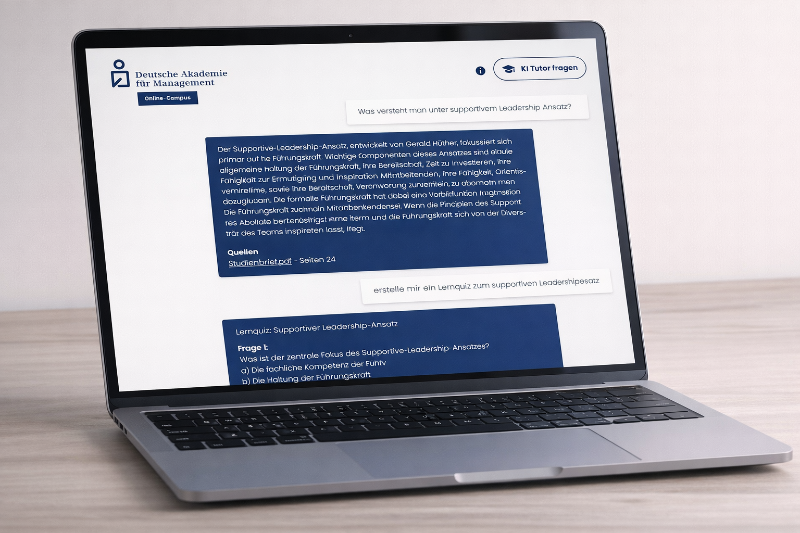
The system uses Pinecone as a vector database and is deliberately limited to answering questions about course content. Queries outside the learning content are not considered to keep the focus on individual learning.
Learners receive 24/7 support for subject questions as well as precise answers on definitions, theory models, and case studies.
The tutor is positioned as a clearly focused Q&A tool within defined learning content.
IU International University was the first university in Germany to develop a comprehensive learning companion with Syntea — not an AI tutor like the others. It supports students not only in self‑study phases but also in managing their studies. A strong focus is on building learning habits.
Syntea supports IU distance learners 24/7 and combines personalized learning with study organization. The special part: Syntea is fully conversational — instead of just delivering answers like typical chatbots, it asks targeted follow‑up questions and interacts like a real conversation. This fosters critical thinking and helps identify knowledge gaps.
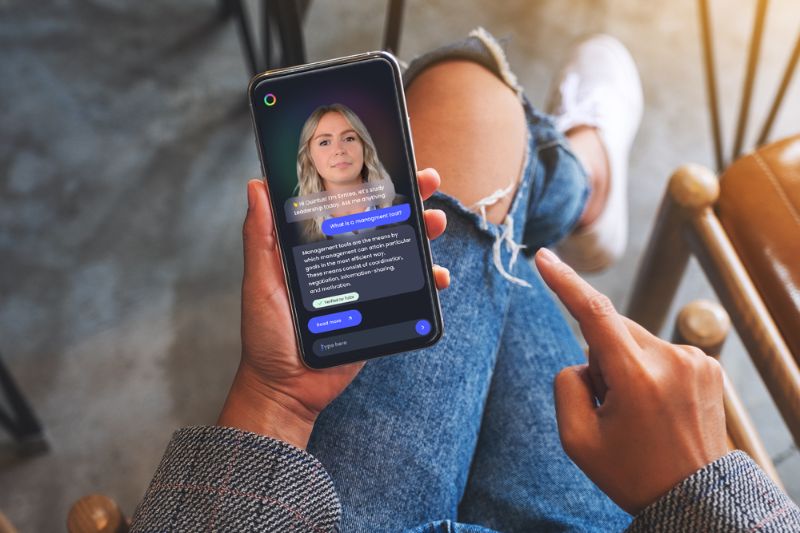
Course‑related answers are verified by instructors. For its innovation, Syntea received the prestigious Gold Award at the QS Reimagine Education Awards in December 2025.
The short profiles of each AI tutor make one thing clear: requirements vary greatly depending on the education context. Learning objectives, target groups, exam formats, and didactic concepts determine how an AI tutor must be configured, deployed, and evolved.
An AI tutor is not a static product that is integrated once and then used unchanged. It is a dynamic system that is adjusted in operation — for example based on user interactions, typical comprehension issues, or changes in course content and exam formats.
The following overview groups the differently deployed AI tutors by shared core functions. It highlights which functional building blocks now form the foundation of modern AI tutors — regardless of education context or didactic approach.
| Funktion | Alphabees | IU (Syntea) | AKAD (Valters) | Klett (AILEA) | DAM | WBS (Kitu) |
|---|---|---|---|---|---|---|
| Questions about learning content | ||||||
| Personalized practice | ||||||
| Korrektur & Feedback | ||||||
| Source references | ||||||
| Sessionspeicherung | ||||||
| Adaptives Verhalten | ||||||
| Active learning support | ||||||
| Learning progress tracking | ||||||
| Analytics | ||||||
| White‑label ready |
By 2026, the education market is in a clear phase of transformation. AI tutors are no longer an experiment; they are increasingly used as a fixed part of learning infrastructure and expected by learners.
For education providers, the question is less whether an AI tutor makes sense and more where strategic priorities lie. The examples here show: in‑house builds offer maximum control but come with high costs, significant staffing effort, and long‑term technical responsibility.
At the same time, it becomes clear that the strategic value of AI tutors for most institutions does not lie in developing AI technology itself. What matters is how AI is used didactically to better support learners, analyze learning processes, and continuously improve offerings.
Education providers whose focus is on creating and distributing high‑quality learning content — not coordinating in‑house AI development teams — find an immediately usable and scalable solution in the Alphabees AI Tutor.
Learn how the Alphabees AI Tutor can be integrated didactically into existing learning environments
Here you’ll find more information about the Alphabees AI Tutor and our services.
Got more questions about Alphabees or the AI tutor? Our AI support bot is trained on all our knowledge — it can likely answer right away.